
India's GDP is estimated to grow at 7.4 per cent in the financial year 2022-23 with rising prices triggered by the Russia-Ukraine conflict posing as the biggest challenge to the global economic recovery, Ficci's Economic Outlook Survey released on Sunday said. According to the survey, the Reserve Bank of India (RBI) is likely to start a rate hike cycle in the second half of 2022, while a repo rate hike of 50-75 bps is expected by the end of the current fiscal. The RBI is expected to continue supporting the ongoing economic recovery by keeping the repo rate unchanged in its April policy review, the survey said.

Though electoral verdicts have historically been accepted, even though grudgingly, by all parties, there has been a sharper edge to the questions being raised by Opposition parties this time over the polling process, including the Election Commission.

While Sunak has maintained a dignified silence over the recent crisis, his supporters have not lost any opportunity to point out how the former finance minister had got the economic forecasts right.

The decisive election victory for the Narendra Modi-led National Democratic Alliance has created a conducive environment for policy actions and should help in economic recovery, Reserve Bank of India Governor Raghuram Rajan said on Tuesday.

"This year, at the Planning Commission, we expect growth rate will be around 8 per cent. We are not expecting 9 per cent in the year 2011-12," Ahluwalia said while speaking at the convocation ceremony at Vijna Jyothy Institute of Management.
'If all goes well, we may well hit or even surpass the forecast growth rate.'

Those hardest hit by the second wave of the pandemic have been blue-collared workers, doctors and healthcare workers, law and order and municipal personnel, individuals eking out daily livelihood, and small businesses. And there should be more measures taken to alleviate their pain, the Reserve Bank of India (RBI) said on Monday. The report also indicated that the RBI's growth numbers might have to be revisited as the central bank's real GDP growth projection of 26.2 per cent given in the MPC's resolution of April 7 for the first quarter of 2021-22, were "made before the full fury of the resurgence." Nevertheless, the "resurgence of COVID-19 has dented but not debilitated economic activity in the first half of Q1: 2021-22.

D&N cites positive changes in momentum in certain segments of economy, but says some areas of concern remain

Have the markets already played out their dynamics before the economy has even properly taken off? Are we now destined for a period of mediocre returns despite a strong economy? asks Akash Prakash.

The IMF's predictions for India's near-term growth may seem rosy, but the usual caveats apply - that is, we are apt to under-perform.

Days after Moody's cut its gross domestic product (GDP) forecast for financial year 2022-23 (FY23) after the official GDP print for the June quarter came in lower than expectations, the global ratings agency said it would maintain its long-term sovereign debt credit rating and outlook on Asia's third-largest economy. "The credit profile of India reflects key strengths, including its large and diversified economy with high growth potential, a relatively strong external position, and a stable domestic financing base for government debt," Moody's said on Tuesday. "We do not expect rising challenges to the global economy, including the impact of the Russia-Ukraine military conflict, higher inflation, and the tightening financial conditions on the back of policy tightening, to derail India's ongoing recovery from the pandemic in 2022 and 2023," it said.

Macroeconomic data announcements, global trends and trading activity of foreign investors would guide momentum in the equity market this week, analysts said. Markets ended a five-week losing streak and gained nearly a per cent last week, helped by a sharp rebound on Friday. Last week, the BSE benchmark jumped 500.65 points or 0.77 per cent and the Nifty gained 169.5 points or 0.87 per cent.

The Indian economy will grow at around 6.5 per cent in the current fiscal, notwithstanding high crude oil prices and increased uncertainty due climate changes, NITI Aayog member Arvind Virmani said on Thursday. Virmani also asserted that the gross household savings ratio in India has consistently gone up. In an interview with PTI, he said: "My growth projection (of India's GDP growth) is 6.5 per cent plus minus 0.5 per cent... because my experience is that the fluctuations in global GDP more or less has balanced out for us, assuming normal changes."

A survey by industry body Ficci has lowered the country's economic growth forecast for 2013-14 fiscal to 5 per cent, from 6 per cent projected in July, indicating tough times ahead.

The International Monetary Fund (IMF) has said India and China will account for half of the global economic growth in 2023, as the multilateral agency retained its growth forecast for Asia's third-largest economy for 2023-24 (FY24). "India remains a bright spot. Together with China, it will account for half of global growth this year, versus just a tenth for the US and euro area combined," the IMF said in its latest update to the biannual World Economic Outlook. Growth in India is set to decline from 6.8 per cent in 2022 (FY23) to 6.1 per cent in 2023 (FY24) before picking up to 6.8 per cent in 2024 (FY25), the global lender said while citing "resilient domestic demand despite external headwinds".

In 1930, John Maynard Keynes predicted that by 2030 technology would be so advanced that three hours of work per day would suffice. Has AI brought about the transformation that Keynes predicted, asks Atanu Biswas.

Unlike the Advance Estimates which missed the impact of demonetisation, CEA's survey is likely to have a better take on Indian economy.

Analysts and economists have hailed the fiscal projections in the interim Budget, saying the lower fiscal deficit forecast shows that the government, even in an election year, is serious about fiscal consolidation and that the numbers look achievable. According to Devendra Kumar Pant, the chief economist at India Ratings, the two broad themes of the interim Budget are fiscal consolidation and stepping up focus on agriculture/rural to course correct, to some extent, the differential benefits of the ongoing economic growth that's tilted in favour of upper-income bracket/urban households. The projected fiscal deficit numbers for FY24 and FY25 suggest that the government is serious about achieving the fiscal consolidation path of 4.5 per cent fiscal deficit by FY26, and given the nominal GDP growth assumption and revenue buoyancy, the target appears plausible, Pant said in a note.

The Reserve Bank of India on Wednesday retained its growth projection at 7.2 per cent for the current fiscal on the back of improvement in urban demand and gradual recovery in rural India. Unveiling the third monetary policy for the current fiscal, RBI Governor Shaktikanta Das said the Indian economy remained resilient, and the central bank will continue to support growth. The RBI expects growth in the first quarter of the current fiscal at 16.2 per cent, which will taper to 4 per cent by the fourth quarter.

The number of ultra-high net worth individuals (UHNWIs) in India is expected to rise 58.4 per cent in the next five years from 12,069 in 2022 to 19,119 in 2027, a report by property consultancy Knight Frank said on Wednesday. In its "The Wealth Report 2023", Knight Frank said that the number of Indian UHNWIs, with a net worth of $30 million or above, fell 7.5 per cent in 2022 due to economic slowdown, rate hikes, appreciation of the US dollar and geopolitical uncertainties. Globally, the number of UHNWIs fell 3.8 per cent in 2022 compared to 2021.

Asian Development Bank (ADB) has kept its outlook for India's economic growth unchanged at 7 per cent for the current fiscal year while forecasting a weaker-than-previously expected pace for developing Asia. ADB's 7 per cent growth projection for fiscal 2022-23 (April 2022 to March 2023), unchanged from its September forecast, compares to 8.7 per cent GDP growth in 2021-22. For 2023-24, the GDP growth has been kept unchanged at 7.2 per cent.

Arvind Subramanian, a senior fellow at the Peterson Institute for International Economics, was informally recommended to the post by Finance Minister Arun Jaitley.

The central bank maintained its bias towards a rate hike.
RBI's latest rate cut is positive for the economy.
The Reserve Bank on Wednesday marginally lowered the country's GDP growth projection for the current fiscal at 6.8 per cent from its earlier estimate of 7 per cent. However, despite the downward revision in the economic growth projection, India will remain among the fastest growing major economies in the world, said RBI Governor Shaktikanta Das while announcing the latest bi-monthly monetary policy.

India, along with Southeast Asian countries such as Indonesia, is expected to sustain growth in the medium-term in Asia region, replacing China as the key growth driver, Morgan Stanley and Nomura said in two separate reports released on Monday. While Morgan Stanley projected a 6.2 per cent gross domestic product (GDP) growth forecast for India in FY24, Nomura estimated the Indian economy to grow at 5.9 per cent in 2023. "Even with a slowing China, we expect GDP growth in Asia to sustainably outperform other emerging markets and the US. India and Southeast Asia are set to be the fastest-growing economies this decade.

'Investment creates capacity and reduces inflation. Income, employment, and savings rise.'

'With China falling out of favour, India is where investors see the demographic and digital dividend apart from the benefits of reforms playing out.' 'Your prime minister has also done a great job of sharing this story with the world.'

Digital literacy is emerging as the professional language of 2024. It is the ability to process complex data sets, deploy critical communication technologies appropriately and validate your importance at your workplace, explains Jagdeep Kochar, managing director, Baker & Taylor India.
Moody's Investors Service on Wednesday raised India's economic growth estimate for 2023 to 5.5 per cent from 4.8 per cent pegged earlier, on the back of a sharp increase in capital expenditure in the Budget and a resilient economic momentum. It however revised downwards India's growth estimate for 2022 to 6.8 per cent from 7 per cent pegged in November last year. In its February update to Global Macro Outlook 2023-24, Moody's raised the baseline 2023 real growth projections "meaningfully" for several G20 economies, including the US, Canada, the Euro area, India, Russia, Mexico, and Turkiye, accounting for a stronger end to 2022.

The first five months of 2023 have witnessed at least six major events/trends that augur badly for global economic and socio-political prospects, points out Shankar Acharya, former chief economic adviser to the Government of India.

Market participants attribute the stability to the Reserve Bank of India's timely intervention in the foreign exchange market, both in terms of selling and buying dollars.

The services sector growth in India rose to a 13-year high in September on sharp increase in new business amid strong demand conditions, and job numbers continued to increase as overall business mood improved, a monthly survey said on Thursday. The seasonally adjusted S&P Global India Services PMI Business Activity Index rose from 60.1 in August to 61 in September, signalling a sharp upturn in output. In Purchasing Managers' Index (PMI) parlance, a print above 50 means expansion while a score below 50 denotes contraction.

Online travel portals and airlines say the demand from companies is being led by essential services sectors like pharmaceutical, oil and gas, and power.

The only real solution to the jobs crisis, whether in India or abroad, is to direct tech innovation towards job enhancing sectors, and disincentivising job-replacing ones, observes R Jagannathan.
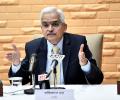
The Reserve Bank of India (RBI) on Wednesday raised the benchmark lending rate by 35 basis points to 6.25 per cent in a bid to tame inflation, which has remained above its tolerance level for the past 11 months. With the latest hike, the repo rate or the short-term lending rate at which banks borrow from the central bank now has crossed 6 per cent. This is the fifth consecutive rate hike after a 40 basis points increase in May and 50 basis points hike each in June, August and September.

Ahead of the Union Budget for 2023-24, Budget makers have welcomed the global consensus view that India will remain one of the bright spots in calendar year 2023. But there is some alarm over the grim global situation and how that might impact the Centre's projections and assessments for next financial year. The big global headwinds include a deep and sustained recession in the West, including India's biggest trading partners in North America and Europe, continuing volatility in commodity markets, and renewed Covid-19 fears, as lifting of strict curbs by China could potentially lead to a massive spread again.

The rupee depreciated by 9 paise and settled at its all-time low level of 83.13 against the US dollar on Wednesday, weighed down by a surge in crude oil prices and strong American currency. Forex traders said the Indian rupee depreciated as the US dollar rose to the highest levels in six months. Moreover, elevated crude oil prices also weighed on rupee.

'The actions of Indian monetary authorities will depend on how quickly they want the inflation to come down to 4 per cent.'

Standard Chartered on Friday lowered India's growth forecast for the current financial year to 4.7 per cent from earlier 5.5 per cent, citing "upside risks" to inflation and fiscal deficit.
